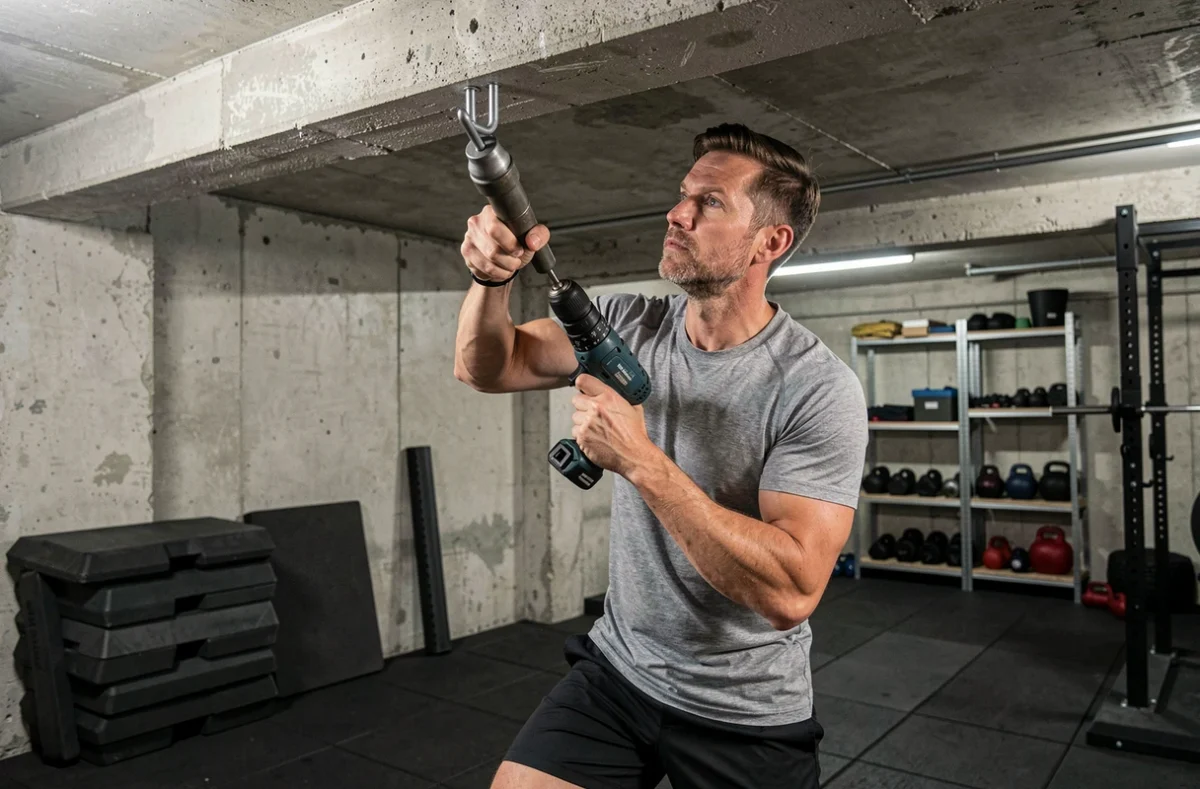
A heavy bag suspended from the ceiling generates dynamic loads with every impact that far exceed its static weight. Its swinging motion amplifies the forces transmitted to the anchors, supporting structure and adjacent floors. Mounting a heavy bag to the ceiling is therefore about more than choosing a hook that can support the bag’s weight: the entire assembly (slab, anchor, mounting plate, chain and spring) must be rated for repeated, multidirectional loads.
Vibrations and noise transmitted to the floor above: the test nobody does before drilling
A bag that swings and absorbs punches sends vibration waves through the slab. In an apartment building, these vibrations travel through the structure to the apartment above, and sometimes even farther. Before installing a permanent mount, carry out a basic acoustic assessment.
The idea is simple: simulate the load. Temporarily attach a weight equivalent to the bag (a weighted bag or filled container) using a strap looped around a joist or a temporary anchor. Hit it for a few minutes and ask a neighbor to assess the noise upstairs. This basic test reveals how well the slab absorbs impacts.
If the noise is noticeable, there are several ways to isolate the vibrations:
- Fit a rubber vibration isolator or damper between the hook and the chain to filter out high frequencies before they reach the slab.
- Add a suspension spring to lengthen the time over which energy is transferred and reduce the vibration peak transmitted to the ceiling.
- Use a wide mounting plate (with at least four anchor points) to distribute the forces over a larger area and prevent vibrations from concentrating at a single point.
In a condominium, the building rules may restrict heavy-duty fixings and impact noise. Depending on whether you own or rent, getting written approval from the property manager or landlord can help avoid disputes later. We recommend securing this approval before drilling.
For a closer look at the full method and different mounting options, this detailed guide explains how to hang a heavy bag from the ceiling step by step.
Anchoring into a concrete slab: chemical or mechanical anchors
The type of concrete determines which anchor to use. High-quality solid concrete can accommodate standard mechanical expansion anchors. Prestressed, cracked or thin concrete calls for chemical anchoring, which is more tolerant of internal stresses in the material.
Chemical anchoring: installation procedure
Chemical anchors (vinylester or epoxy resin) offer high pull-out resistance, provided the installation procedure is followed carefully. Drill to the exact diameter specified by the resin manufacturer, using a suitable bit (do not use hammer mode on prestressed concrete).
Cleaning the hole is the most commonly overlooked—and most critical—step. Residual dust, moisture or concrete fragments reduce the resin’s bond strength. At a minimum, brush the hole twice with a spiral wire brush, then blow it clean. Allow the resin to cure fully before applying any load; curing time varies with the ambient temperature.
Mechanical anchors: limitations
Expansion anchors work well in solid, uncracked concrete. Their strength depends on the effective embedment depth: an anchor that is too short in a thin slab can cause a concrete breakout cone. The minimum embedment depth is listed in the product’s European Technical Assessment (ETA). If the slab is thinner than this minimum, do not use a mechanical anchor.
Wooden ceiling: locating the load-bearing joist
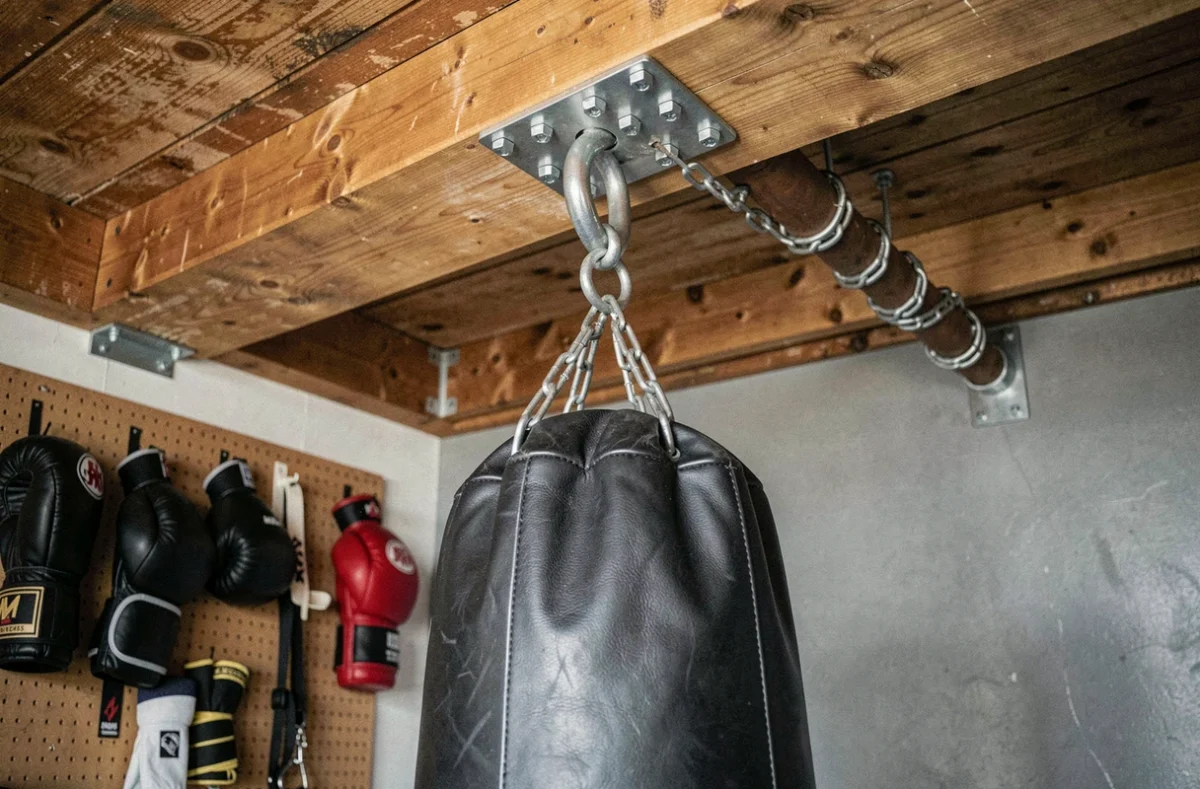
In a timber-frame home or a basement with exposed joists, the mount must be fixed directly into a joist—never into paneling, particleboard or a plasterboard false ceiling. Plasterboard is not a structural anchor point, even when used with specialist anchors.
Use a stud finder to locate the joist or, if you don’t have one, tap the surface to identify it. Once located, a through-bolted lag screw (at least 10 mm in diameter) provides the most reliable fixing. The lag screw must enter the center of the joist to a depth of at least two-thirds of the timber’s cross-section.
Then bolt the suspension plate to the underside of the joist. If the joists are hidden behind a false ceiling, cut an access hatch so you can work directly on the load-bearing timber. Any attempt to fix the mount through the plaster without reaching the joist will end in a pull-out, often after just a few training sessions.
Suspension chain: every link matters
A common mistake is to oversize the anchor while neglecting an intermediate link. A low-quality carabiner, undersized chain or unsuitable swivel can create a point of failure.
- The chain must be made of welded steel and have a cross-section sufficient to withstand the dynamic load (the bag’s weight multiplied by the impact factor generated by punches).
- A ball-bearing swivel lets the bag rotate freely and prevents the chain from twisting, reducing lateral forces on the anchor.
- The carabiner connecting the chain to the hook must have a locking mechanism (such as a screw-lock carabiner), not a simple spring-gate carabiner that could open under an angled pull.
- Every component in the suspension assembly must have a load capacity greater than that of the weakest link, not merely the bag’s static weight.
Check the entire suspension assembly before every session: look for worn links, play in the swivel and a loose hook. A quick visual check takes less than a minute and prevents most household accidents involving heavy bags.
Mounting a heavy bag to the ceiling puts stress on the building’s structure. A properly installed anchor in the right substrate, combined with a complete, inspected suspension assembly, ensures years of training without unpleasant surprises. If you have any doubts about the type of slab or the joists’ load-bearing capacity, hiring a building professional is the only sensible option.