
The border is the space located between the lawn and the garden. A good delineation of this space has many advantages. It facilitates lawn mowing and encourages the regular growth of grass… Moreover, it reduces water evaporation and ensures good plant development. Here are some tips for properly defining the borders of your lawn.
Tips for Properly Defining Lawn Borders
To successfully delineate your garden, you must first define your needs. Indeed, there are several types of garden borders: English borders, stone borders, natural borders… You must also choose the layout suitable for the edges of your borders: they can be laid or built. Next, you need to define the use of your borders. Then, you should determine the ideal size for your borders. This refers to the size of the flowerbed behind the borders. It should be in harmony with the garden.
Furthermore, the larger the size, the more maintenance will be required. Plants also play an important role in creating borders. The most commonly used are perennials, grasses, and evergreen shrubs… Finally, you should mulch the borders to maintain soil moisture. Mulching is also a means to easily weed the soil. You can choose between organic mulch and mineral mulch. Organic mulch is made of hemp, while mineral mulch comes from slate flakes.
Case of Delimiting an English Lawn Border
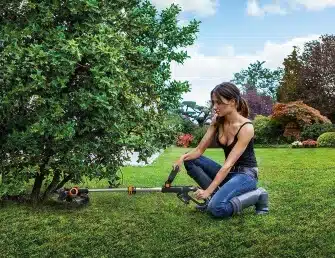 To delineate an English lawn border, you need to follow 5 main steps. First, prepare a cutting tool such as a cordless trimmer. In this case, use a lawn mower.
It is a device equipped with a semi-circular sharp blade and a long handle. Before starting the operation, sharpen the blade properly so that the cut is uniform. Additionally, you can also use a pointed spade.
Secondly, to delineate the longest edges, stretch a string to create a straight line. Thirdly, level the grass using the lawn mower or the spade. Fourthly, remove the debris from the cut areas. You can use them as fertilizer for certain damaged spots on the lawn. Finally, to fill in the soil losses at the borders, add potting soil.
Case of Delimiting Stone Borders and Natural Borders
To create a stone border, simply dig a hole a few centimeters deep between the lawn and the flowerbed. Fill the trench with sand and place the stones. A flowerbed of flowers and shrubs can also serve to define the borders of a lawn. In this case, we refer to a natural border. It is defined with plants such as thyme, geranium, dwarf lavender, or veronica. The compact shape of these plants helps limit the spread of grass.
Delineating the borders of a lawn contributes to its beautification. The method to be used depends on the type of borders desired.